

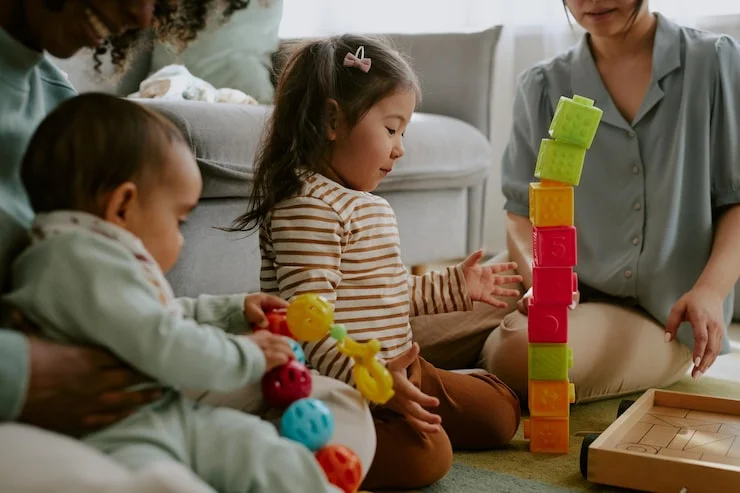
Most parents do not need another list of crafts to pin on Pinterest. They need to know what actually helps a child’s brain grow, what can be done in ten minutes between dinner and bath time, and what to skip because it just adds pressure. The research on early childhood development points to something reassuring: the activities that matter most are not complicated, expensive, or Instagram-ready. They are the small, repeated moments of back-and-forth interaction that happen in child development activities for parents.
This guide walks through what those moments look like at different ages, why they work, and how to build them into a day that already feels full. No special supplies required.
Why simple play beats structured classes?
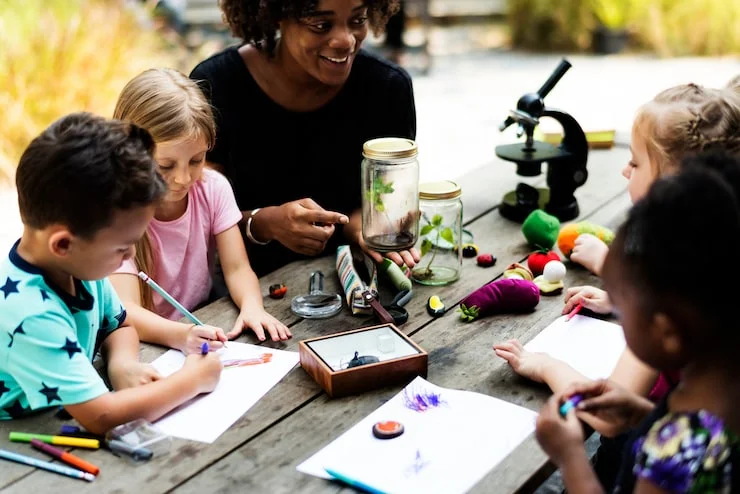
Harvard’s Center on the Developing Child describes play as a core part of building sturdy brain architecture, especially when an adult is involved . The key ingredient is not the activity itself. It is the back-and-forth exchange between a child and a caregiver. Harvard calls this “serve and return.” A baby coos, you coo back. A toddler points at a dog, you look at the dog and name it. A preschooler hands you a block, you take it and ask what to know about child development activities for parents.
This exchange matters because it activates and strengthens neural connections in the brain. Studies cited by Harvard show that children who experience more conversational turns show greater brain activation in language regions, and that sensitive, responsive caregiving is linked to healthier brain development at age eight . The implication is straightforward. You do not need to be a trained educator to do this. You need to notice what your child is offering and respond to it.
UNICEF’s guidance for parents reinforces the same point. Play is not a luxury or an extra task to schedule. It is how children learn best. Expensive toys and gadgets are not required. Time, attention, and love are the most valuable things a parent can give.
Read Also: Positive Discipline Strategies For Parents
Activities for babies and toddlers (birth to three)
The first three years are a period of rapid brain development. Babies learn through touch, sight, sound, and movement, and they rely on adults to make sense of the world around them .
Talk through ordinary tasks. Narrate what you are doing while you do it. “Now I’m washing your hands. Here is the soap. It feels slippery.” This feels strange at first. Most parents get used to it within a week. Naming objects and actions helps babies connect words to meaning, even before they can speak .
Respond to sounds and gestures. When your baby makes a noise, make one back. When they point, look at what they are pointing at and talk about it. Harvard describes this as the foundation of conversation, and it builds both language and social connection . This is also the easiest activity on this list because it requires nothing except your attention.
Use what is already in the kitchen. Safe household objects like plastic cups, wooden spoons, and soft cloths are excellent for exploration. Touching different shapes and textures helps a baby’s senses develop . You do not need to buy a basket of sensory toys. A drawer of safe utensils works just as well.
Give them floor time. Tummy time and open floor space let babies roll, reach, and eventually crawl. This builds strength and body awareness . A blanket on the floor and a few safe objects nearby is enough.
Sing and clap. Simple songs and clapping games build memory, hearing, and a sense of rhythm. They also build language before a child can speak . If you feel silly singing alone, remember that your baby is the least judgmental audience you will ever have.
Activities for preschoolers (Three To Eight)
At this age, children become curious, imaginative, and eager to test boundaries. Everyday tasks and games become powerful learning moments .
Encourage pretend play. Dolls, animal figures, kitchen items, or empty boxes can all become something else. When a child “cooks” or “teaches” or “plays shop,” they are building creativity, storytelling ability, and an understanding of how the world works . Resist the urge to direct the scene. Let them lead.
Fold laundry together. This sounds like a chore, and it is. But handing a child socks to match or towels to fold teaches sorting, responsibility, and the feeling of being helpful. UNICEF recommends involving children in simple daily tasks like folding clothes, arranging vegetables, or watering plants . The goal is not efficiency. It is participation.
Ask about what you see. “What color is the sky today?” “What shape is that cloud?” These questions spark thinking and build vocabulary without requiring a worksheet or a lesson plan . They also signal to a child that their observations matter.
Use local games. Traditional games like hopscotch, hide-and-seek, or simple chasing games improve physical coordination, problem-solving, and social skills . They also connect children to the culture and community around them, which matters for identity and child development activities for parents.
You May Alxso Like: Gentle Parenting Burnout Recovery
Activities for older children (eight to eleven)

Children at this stage want more independence and enjoy solving problems, expressing opinions, and trying new things . The parent’s role shifts slightly. You are less of a playmate and more of a guide.
Ask open questions. “What would you do if that happened?” “Why do you think that character made that choice?” Questions like these develop reasoning and emotional expression . They also give you a window into how your child is thinking about the world, which is useful information for any parent.
Let them take the lead. Involve children in planning meals, making lists, organizing schoolwork, or teaching you a game they know. This gives them a sense of control and responsibility . It also shows that you trust their judgment, which builds confidence.
Read and write in small moments. Read street signs, recipes, or instructions together. Ask them to write a grocery list or a short note to a relative. UNICEF recommends everyday reading and writing as a way to build language skills and confidence . These do not need to be formal lessons. They just need to happen.
Support whatever they are into. Whether it is drawing, building, bugs, or fixing things, encouraging a child’s interests helps them grow their talents and self-esteem . You do not need to share the interest. You just need to make space for it.
What to ignore (politely)?
There is a lot of pressure on parents to buy the right toys, enroll in the right classes, and create the right environment. The evidence does not support most of that pressure. HealthLinkBC notes that the best toys encourage a child to learn, explore, and use their imagination, and that they do not need to be fancy or expensive. Fewer toys can actually improve a child’s ability to engage, because too many options become overwhelming .
The same principle applies to activities. A child does not need a schedule full of enrichment. They need unstructured time, outdoor play when possible, and an adult who is paying attention . If you can offer those three things, you are already doing the work that child development activities for parents.
Conclusion
Parents often wonder whether they are doing enough. The research suggests that “enough” is smaller and more ordinary than most people think. It is the five minutes of talking through handwashing. It is the response to a coo. It is the question about the shape of a cloud. These moments do not require planning, money, or a special skill set. They require presence.
Harvard’s serve and return framework is built on the idea that small, repeated interactions shape a child’s development over time . You will not get every moment right. You will be tired, distracted, and busy. That is fine. The goal is not perfection. It is enough responsive moments, repeated often, that a child feels seen and supported. That is the foundation everything else builds on.
Other Articles
50 Popular Gujarati Surnames Or Last Names With Meanings