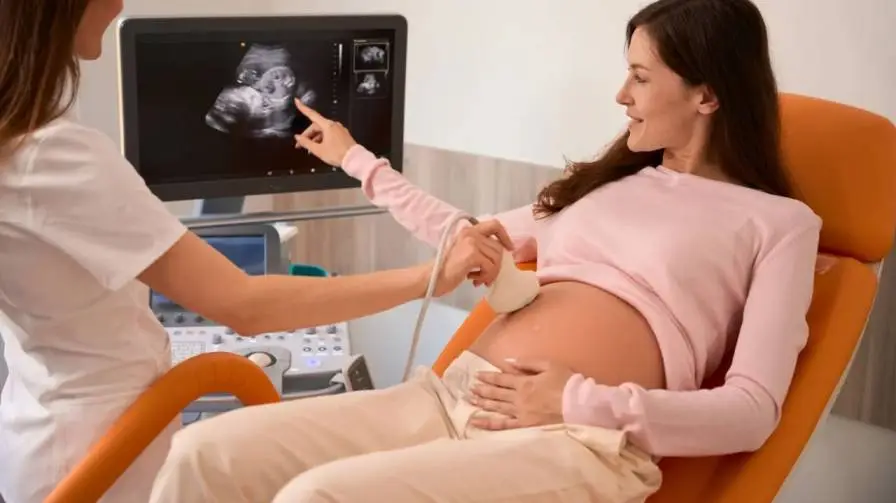

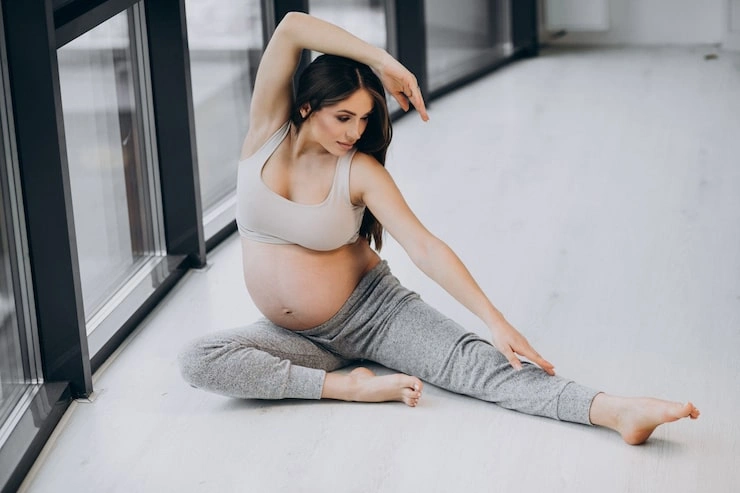
Bringing a new life into the world is a beautiful thing. Your body is doing something amazing. But it is also working very hard. You might feel tired. You might have back pain. You might feel stressed. This is normal. Many women feel this pregnancy yoga exercises for beginners at home.
There is something that can help you feel better. It is called pregnancy yoga. You do not need to go to a class. You can do it right at home. You do not need to be flexible. You do not need any special skills. You just need a quiet space and a mat.
This guide is for you if you are new to yoga. It is for you if you are pregnant and want to move your body safely. We will talk about why yoga is good for you. We will talk about how to stay safe. We will show you simple poses you can do at home. We will also tell you what to avoid. Let us get started.
Why Pregnancy Yoga Is Good For You?
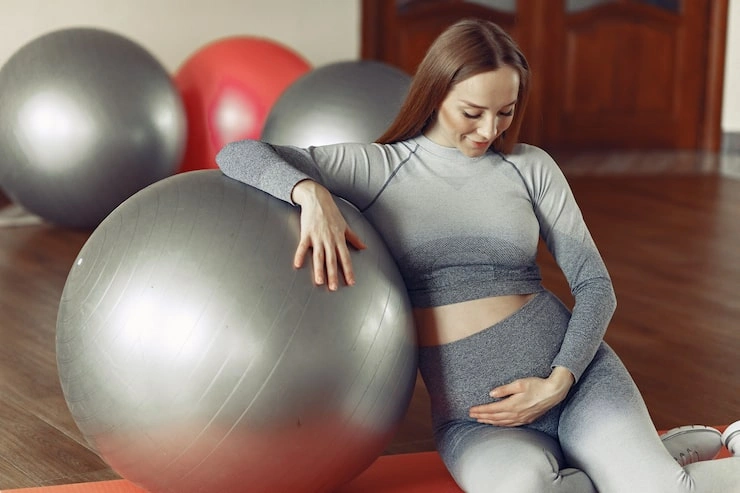
Pregnancy yoga is not just about stretching. It helps your body and your mind . It can make your pregnancy more comfortable. It can even help you get ready for labor.
Helps With Pain And Discomfort
Your body changes a lot during pregnancy. Your belly gets bigger. Your back has to carry more weight. This can cause back pain . Your hips can feel tight. Your feet and ankles can swell.
Yoga can help with these problems. Gentle stretching can ease the pain in your back . Certain poses can open your hips. Some poses can help reduce swelling in your feet. Moving your body helps your blood flow better . This is good for you and your baby.
Read Also: Pregnancy Skincare Routine Safe In India
Reduces Stress And Anxiety
Pregnancy can be an emotional time. You might worry about the baby. You might worry about labor. You might feel stressed about becoming a parent. These feelings are very common.
Yoga helps you relax. It teaches you to focus on your breath. Deep breathing calms your nervous system . It can lower the stress hormone in your body. Studies show that prenatal yoga can reduce anxiety and depression . It can also help you sleep better.
Gets Your Body Ready For Labor
Think of labor as a big event. Your body needs strength and stamina. Your muscles need to work hard. Your pelvis needs to be flexible.
Yoga prepares your body for this event . It strengthens your legs and core. It opens your hips. This can make labor easier. It can also help you manage the pain of contractions. The breathing you learn in yoga can help you stay calm during labor . Some research shows that women who do yoga have shorter labors .
Important Safety Rules Before You Start
Before you do any yoga, you need to be safe. This is the most important part of this guide. Always put your safety and your baby's safety first.
Talk to your doctor first. This is the number one rule. Do not start any new exercise without asking your doctor . They know your health history. They can tell you if yoga is safe for you.
Listen to your body. This is the number two rule. You know your body best. If a pose hurts, stop doing it. If you feel tired, rest. Do not push yourself too hard. Pregnancy is not the time to try very hard things. You should be able to talk while you exercise. This means you are working at the right level .
Stay cool. Do not do yoga in a hot room. Do not do hot yoga. Getting too hot is not safe for your baby . It can make you dizzy. It can make you feel sick. Always practice in a cool, airy room. Drink water before, during, and after your practice .
Stop and call your doctor if you have any of these signs:
-
Fluid leaking from your vagina
-
Dizziness or feeling faint
-
Calf pain or swelling
-
Your baby is moving less than usual
-
Belly cramps or backaches
-
Bleeding or spotting
These signs are important. Do not ignore them. If you feel any of them, stop your practice and get medical help.
What To Avoid During Pregnancy Yoga
There are some moves that are not safe for pregnant women. You should not do them .
Do not lie flat on your back after the first trimester. This is very important. After 13 weeks, your baby is getting bigger. The weight of your baby can press on a big blood vessel. This can cut off blood flow to your baby. It can also make you feel faint . If you want to rest, lie on your side.
Avoid deep twists. Twisting your belly can put pressure on your abdomen. It can also be uncomfortable. If you do a twist, twist from your shoulders and chest. Do not twist from your belly .
Avoid very deep backbends. Deep backbends can strain your back. They can also be hard to balance. This can cause you to fall.
Be careful with deep squats and wide lunges. These can put a lot of pressure on your pelvic floor. Some women should not do them. It is better to be safe and use a chair or a wall for support .
Do not hold your breath. Breathing is very important in yoga. Always keep your breath smooth and steady. Holding your breath puts pressure on your body. It is not good for you or your baby.
Do not overstretch. There is a hormone called relaxin in your body. It makes your ligaments looser. This helps your body get ready for birth. But it also makes you more flexible. You can stretch too far and hurt yourself . Do not go to your full edge. Keep your movements gentle and controlled.
Simple Pregnancy Yoga Poses For Beginners At Home
Here are some safe and gentle yoga poses. You can do them at home. Start with a few poses. Do them slowly. Pay attention to how you feel.
Cat-Cow Pose (Marjaryasana-Bitilasana)
This is a great pose for back pain. It also helps your baby get into a good position. It is a gentle movement for your spine.
-
Start on your hands and knees. Put your hands under your shoulders. Put your knees under your hips .
-
Keep your back flat.
-
Breathe in. Arch your back. Let your belly drop down. Lift your head up. Look forward. This is Cow Pose .
-
Breathe out. Round your back up like a cat. Tuck your chin to your chest. This is Cat Pose .
-
Move slowly. Do this 5 to 10 times. Follow your pregnancy yoga exercises for beginners at home.
Wide-Knee Child's Pose (Balasana)
This pose is very relaxing. It stretches your back. It gives your belly room to rest. It is a good pose to do anytime you need a break.
-
Start on your hands and knees.
-
Open your knees wide. Bring your big toes together .
-
Sit your hips back onto your heels.
-
Fold your chest forward. Let it rest between your thighs.
-
Rest your forehead on the mat. You can use a blanket for support.
-
Stretch your arms out in front of you. You can also put them by your sides .
-
Breathe deeply. Stay here for 1 to 2 minutes.
Bound Angle Pose (Baddha Konasana)
This pose opens your hips. It helps with flexibility. It can also help you prepare for labor . It stretches your inner thighs.
-
Sit on the floor. Sit on a cushion or a folded blanket. This makes it more comfortable .
-
Bend your knees. Bring the soles of your feet together.
-
Let your knees drop out to the sides.
-
Hold your feet or your ankles. Sit up tall. Keep your back straight .
-
Breathe deeply. Stay here for 1 to 2 minutes. You can gently press your knees down. But do not force them.
You May Also Like: Foods To Avoid During Early Pregnancy Weeks
Easy Pose (Sukhasana)
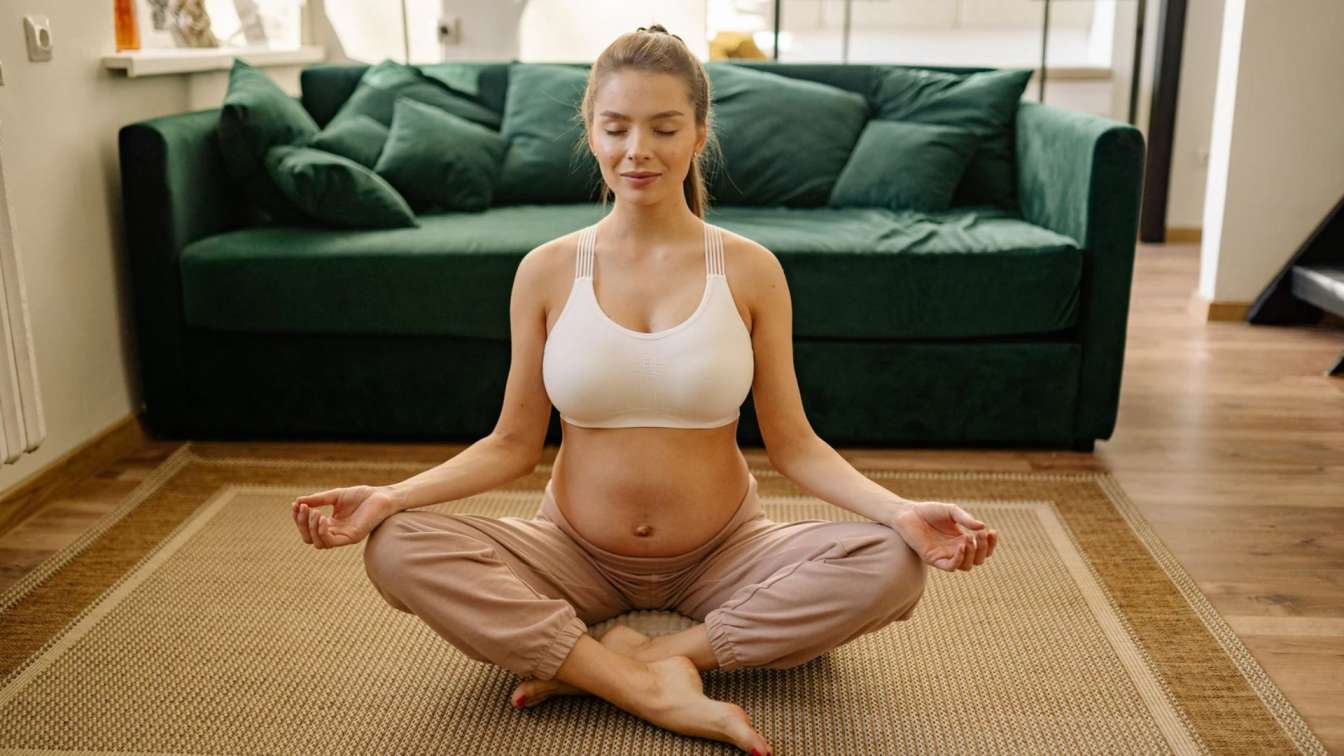
This pose is a simple seated pose. It is good for breathing exercises. It helps you relax and feel calm .
-
Sit on the floor. Use a cushion or a blanket. This will help you sit up straight.
-
Cross your legs. Let your knees drop down.
-
Rest your hands on your knees. You can keep your palms up or down.
-
Close your eyes. Breathe slowly and deeply.
-
Focus on your breath. Stay here for 2 to 5 minutes .
Warrior II Pose (Virabhadrasana II)
This pose builds strength. It works your legs and your arms. It opens your hips. It gives you energy.
-
Stand up. Step your left foot back. Turn your left foot out slightly.
-
Your front foot (right) points forward.
-
Bend your right knee. Make sure your knee is over your ankle . Your knee should not go past your ankle.
-
Raise your arms out to the sides. Keep them parallel to the floor.
-
Look over your right hand. Keep your shoulders down.
-
Hold for 30 seconds. Breathe deeply. Repeat on the other side.
-
Modification: Use a chair for balance. Put your hand on the chair .
Triangle Pose (Trikonasana)
This pose stretches your sides and hips. It can help with back pain. It also improves balance.
-
Stand up. Step your left foot back. Your feet should be wide apart .
-
Turn your left foot out slightly. Your front foot (right) points forward.
-
Reach your right arm down. Place your hand on your shin. You can also place it on a block.
-
Reach your left arm up. Look up at your left hand.
-
Keep your back straight. Open your chest.
-
Hold for 30 seconds. Repeat on the other side.
-
Modification: If you feel unstable, shorten your stance. Do this pose near a wall for support.
Goddess Pose (Utkata Konasana)
This pose strengthens your legs and pelvic floor. It helps your pelvis open. It is a good pose for labor preparation .
-
Stand up. Step your feet wide apart. Turn your toes out.
-
Bend your knees. Lower your hips down. Try to get your thighs parallel to the floor.
-
Press your knees out to the sides. Open your hips.
-
Bring your hands together at your heart. Or stretch them out to the sides.
-
Hold for 30 seconds. Breathe deeply.
-
Modification: You can do this with your back against a wall. This will help you balance.
Supported Squat (Malasana)
This pose helps open your pelvis. It uses gravity to help your baby move down. It can be very helpful for labor .
-
Stand up. Step your feet wider than your hips. Turn your toes out .
-
Bend your knees. Lower your hips down. Try to go into a squat.
-
Bring your hands together at your heart. Press your elbows against your inner knees.
-
Hold for 30 seconds.
-
Modification: Place a block or a blanket under your hips. This will support you. You can also hold onto a chair for balance.
Legs Up The Wall (Viparita Karani)
This pose is very relaxing. It can help with swelling in your feet and ankles. It also helps your blood flow.
-
Sit next to a wall. Lie down on your side.
-
Swing your legs up the wall. Your body should be flat on the floor. Your legs rest against the wall.
-
Place your arms by your side .
-
Relax. Breathe deeply. Stay here for 10 minutes.
-
Important: Do not do this pose in the second or third trimester. It involves lying on your back. This is not safe after the first trimester . You can try a modified version on your side. Lie on your left side. Rest your top leg on a cushion.
Breathing Exercises (Pranayama)
Breathing is a big part of yoga. It is not just about the poses. Learning to breathe deeply can help you relax. It can also help you cope with labor pain.
Deep Belly Breathing
-
Sit in Easy Pose (cross-legged). Or lie on your left side.
-
Put one hand on your belly.
-
Breathe in deeply. Feel your belly push up against your hand.
-
Breathe out slowly. Feel your belly go down.
-
Do this for 5 minutes. Focus on your breath. This calms your nervous system .
Alternate Nostril Breathing
This can help clear your mind. It can also help you feel calm . It is a simple breathing technique.
-
Sit up tall. Use your right hand.
-
Bring your thumb and ring finger to your nose.
-
Close your right nostril with your thumb. Breathe in through your left nostril.
-
Close your left nostril with your ring finger. Open your right nostril. Breathe out through your right nostril.
-
Breathe in through your right nostril.
-
Close your right nostril. Open your left nostril. Breathe out through your left nostril.
-
Do this 5 to 10 times.
A Simple Routine For Home Practice
You do not have to do a long practice. Even 15 minutes can help. Here is a sample routine you can follow.
-
Start with Deep Breathing (2 minutes): Sit in Easy Pose. Close your eyes. Focus on your breath.
-
Cat-Cow Pose (1 minute): Do this slowly. Move with your breath.
-
Wide-Knee Child's Pose (2 minutes): Rest here. Let your back stretch.
-
Bound Angle Pose (2 minutes): Open your hips. Breathe deeply.
-
Warrior II Pose (1 minute each side): Build strength.
-
Triangle Pose (1 minute each side): Stretch your sides.
-
Supported Squat (1 minute): Open your pelvis.
-
Side-Lying Relaxation (5 minutes): Lie on your left side. Close your eyes. Think about your baby. Breathe and relax .
Pregnancy Yoga In Each Trimester
Your body changes each trimester. Your practice should change too.
First Trimester (Weeks 1 to 13)
This is a time of change. You might feel tired and sick. Focus on gentle movement. Do not overheat. Do not overstretch. Focus on breathing and relaxation .
Second Trimester (Weeks 14 to 27)
Your belly is growing. Your center of gravity is changing. This is a good time to build strength. But do not overstretch. Your ligaments are loose. Do not lie on your back. Use props for support .
Third Trimester (Weeks 28 to 40)
Your belly is big. Your focus should be on comfort. Use lots of props. Use a wall or chair for balance. Do gentle hip-openers. Rest a lot. Do breathing exercises .
Conclusion
Pregnancy is a special journey. Your body is doing a wonderful thing. Taking care of yourself is important. It helps you and your baby.
Pregnancy yoga is a safe and gentle way to stay healthy. It can reduce your back pain. It can lower your stress. It can help you get ready for labor. You can do these simple poses in your own home.
The most important thing is to be safe. Always ask your doctor first. Listen to your body. Never push yourself too hard. Use the poses in this guide. Modify them to fit your body. Breathe deeply and relax.
Other Articles
Baby Development Milestones By Month
50 Popular Gujarati Surnames Or Last Names With Meanings