

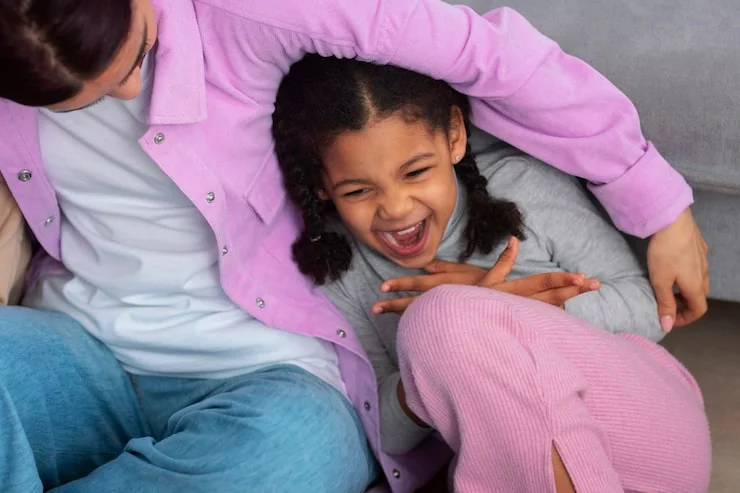
Children are not born knowing how to calm down. They learn emotional regulation by watching you, by feeling safe when their feelings get too big, and by practicing simple calming skills with your help. The most important first step is not to stop the feeling, but to name it and sit with your child inside it.
What Emotional Regulation Really Means for a Child?

Emotional regulation is the ability to notice a strong feeling, manage it, and recover from it. It is not about making feelings go away. It is about helping a child move through anger, sadness, or fear without being swept away by them .
This skill does not appear overnight. It grows slowly across childhood, and it depends on something called co-regulation. Co-regulation is the simple act of an adult lending their calm to a child who has lost theirs. When you stay steady while your child is screaming, you are not ignoring the behavior. You are giving their brain a safe place to land .
Young children need this help because the part of the brain that controls impulses and big emotions is still under construction. It will keep developing well into adolescence . So when a four-year-old melts down because their toast is cut the wrong way, it is not manipulation. It is a nervous system that has hit its limit and does not yet have the wiring to reset itself alone.
Your job is not to prevent every meltdown. Your job is to be the steady presence that teaches their brain what calm feels like, over and over, until they can create it on their own.
Read Also: Healthy Sleep Habits For Kids
Start With Your Own Calm Before You Try to Fix Theirs
This is the part most parenting advice skips, and it is the part that matters most. Children learn far more from what you do in a hard moment than from what you say after it. If you shout at your child to stop shouting, the lesson they absorb is that loud is how you handle being upset .
Before you can help your child settle, you need to check your own body. Are your shoulders tight? Is your voice getting faster? If you are already bubbling over, you cannot be the calm anchor your child needs.
Take one breath before you speak. If it is safe to do so, step back for a few seconds. Splash water on your face. Feel your feet on the floor. Then turn toward your child.
You do not have to be perfect at this. You just have to be willing to try. When you say out loud, “I am feeling frustrated right now, so I am going to take a deep breath,” you are giving your child a live demonstration of the exact skill you want them to learn . That is worth more than a hundred lectures about calming down.
Name the Feeling Before You Try to Change It
When your child is upset, your first instinct might be to solve the problem. You want to fix it. You want the crying to stop. But jumping to solutions too fast tells your child that their feeling is a problem to be eliminated, not something to be understood.
Instead, put the feeling into words. Say what you see. “You are really angry that we have to leave the park.” “You look sad because your friend did not want to play.” “That scared you when the dog barked” .
This is sometimes called emotion coaching. It has three simple parts. First, notice the feeling. Second, name it. Third, validate it by showing you understand why it is teach child emotional regulation.
There is a right way and a wrong way to do this. “Don’t be sad” is the wrong way. It tells the child their feeling is not allowed. “I see you are sad about that. Tell me about it” is the right way . The difference is small in words and huge in effect. One closes the door. The other opens it.
You might worry that naming a feeling will make it bigger. The opposite is true. A feeling that has a name becomes something a child can point to and eventually handle. A feeling that has no name just feels like a storm with no edges.
Stay With Them Instead of Sending Them Away
Many parents were raised with the idea that a child who is upset should go to their room alone until they can be calm. This approach teaches a child that big feelings are something to hide. It also asks them to do something their brain is not yet able to do: regulate alone.
What children need instead is your quiet presence. You do not need to talk. You do not need to explain or correct. You just need to be there, calm and steady, while the storm passes .
If your child will let you, sit nearby. If they push you away, stay at a small distance and say, “I am right here when you need me.” For younger children, a hand on the back or a quiet voice can be enough. For older children, sitting on the floor outside their door can send the same message: you are not alone in this.
This is hard. It takes patience. It can feel like you are doing nothing. But you are doing one of the most important things a parent can do. You are showing your child that their feelings are not too much for you. That message, repeated over time, becomes the foundation of their own ability to handle hard things.
You May Also Like: How To Improve Digestion In Children
Teach Simple Calming Skills When Everyone Is Calm

You cannot teach a drowning person to swim. In the same way, you cannot teach a child a breathing exercise while they are screaming on the floor. Calming skills need to be practiced during calm moments, not during a crisis .
Pick a quiet time, maybe after breakfast or during play. Show your child a simple skill and do it with them. Keep it short and concrete.
Belly breathing. Tell your child to imagine smelling a flower, then blowing out a birthday candle. Breathe in through the nose for a slow count of three. Breathe out through the mouth for a slow count of four. The longer exhale is what helps the body settle .
The turtle technique. Tell your child to imagine they are a turtle. When things feel too big, they can pull into their shell, take three deep breaths, and say to themselves, “I can calm down” .
A calm-down space. This is not a punishment corner. It is a comfortable spot with a soft blanket, a favorite stuffed animal, or a book. Let your child help choose what goes there. When they are calm, talk about how they can use it when they feel upset. The goal is for them to eventually choose it on their own .
Practice these skills when nothing is wrong. Make them a normal part of the day, like brushing teeth. The more familiar they are, the more likely your child will be able to reach for them when they actually need them.
You May Also Like: How To Increase Appetite In Children Naturally
Help Them Notice the Warning Signs Early
Big blowups rarely come out of nowhere. There are almost always small signals first. A child might start complaining. Their voice might get sharper. They might say, “This is not fair,” or pull away from what they were doing .
If you can help your child notice these early signals, you can catch the wave before it crashes. You might say, “I notice you are getting frustrated. Do you want to take a break before it gets too big?” This is not giving in. It is teaching them to read their own body and take action before they are overwhelmed.
For younger children, you will need to do most of the noticing for them at first. You are the external alarm system until their internal one develops. Over time, they will start to recognize the signs themselves.
Keep Routines Steady and Warnings Clear
A child who does not know what is coming next has to spend a lot of energy bracing for surprises. That leaves less energy for handling feelings when they show up.
Clear routines help. Meals at roughly the same time. A predictable bedtime. Knowing what happens after school. These small structures give a child a sense of safety that makes it easier to stay regulated .
Transitions are a common trigger. Give warnings before a change. “Five more minutes at the park, then we go.” “In two minutes, we need to turn off the tablet.” A visual schedule with pictures can help younger children who cannot yet read a clock .
This is not about being rigid. It is about being predictable. A child who trusts that the world is mostly steady can afford to relax a little. And a relaxed child has more room to practice the skills you are teaching.
What to Do When Nothing Seems to Work?
Some days, nothing works. The breathing exercise is refused. The calm-down corner is ignored. The naming and validating is met with louder screaming. This does not mean you are failing. It means your child is having a hard day, and their brain is too overloaded to use any of the skills you have practiced.
In those moments, lower your expectations. Keep them safe. Stay nearby. Say very little. Ride it out. The lesson is not always in the resolution. Sometimes the lesson is simply that you stayed.
After the storm has passed, when everyone is calm and fed and rested, you can talk about it. Not as a lecture, but as a curious conversation. “That was really hard earlier. What do you think made it so big?” “What could we try next time?” Keep it short. Do not force it. The goal is to help them build a story around what happened, not to assign blame .
If your child consistently struggles with emotions in ways that interfere with daily life, school, or friendships, talk to your pediatrician. Some children need extra support, and asking for it is a sign of strength, teach child emotional regulation .
Conclusion
Teaching a child emotional regulation is not about stopping their feelings. It is about showing them, again and again, that feelings can be survived. You do this by staying calm when they cannot, by naming what you see, by sitting with them in the mess, and by practicing simple skills when the sun is shining.
It is slow work. It is repetitive work. Some days it will feel like you are going backward. But every time you respond with steadiness instead of matching their chaos, you are laying down a track in their brain that says: this feeling is big, but I am safe. I can get through this.
Other Articles
50 Popular Gujarati Surnames Or Last Names With Meanings